







AI Pricing for Subscriptions: What Works
Pricing AI subscription products is challenging because AI's compute costs differ from traditional software. While traditional SaaS enjoys high profit margins, AI companies face variable costs for every user interaction, like generating text or images. This has led to new pricing strategies to balance revenue, costs, and customer value.
Key takeaways:
- AI's Cost Challenge: Compute costs make flat-rate pricing risky, especially with heavy users.
- Hybrid Models Work Best: 56% of AI companies use a mix of subscription fees and usage-based charges for predictability and fairness.
- Outcome-Based Pricing: Tying fees to results (e.g., $0.99 per resolved ticket) aligns pricing with delivered value.
- Dynamic Adjustments: AI tools like Stripe and Chargebee help businesses manage real-time metering and flexible pricing.
AI companies must align pricing with customer-perceived value, whether through usage, outcomes, or hybrid models, while leveraging tools to manage costs and scalability effectively.
Pricing your AI product: Lessons from 400+ companies and 50 unicorns | Madhavan Ramanujam
sbb-itb-c336128
Common Pricing Models for AI Subscriptions
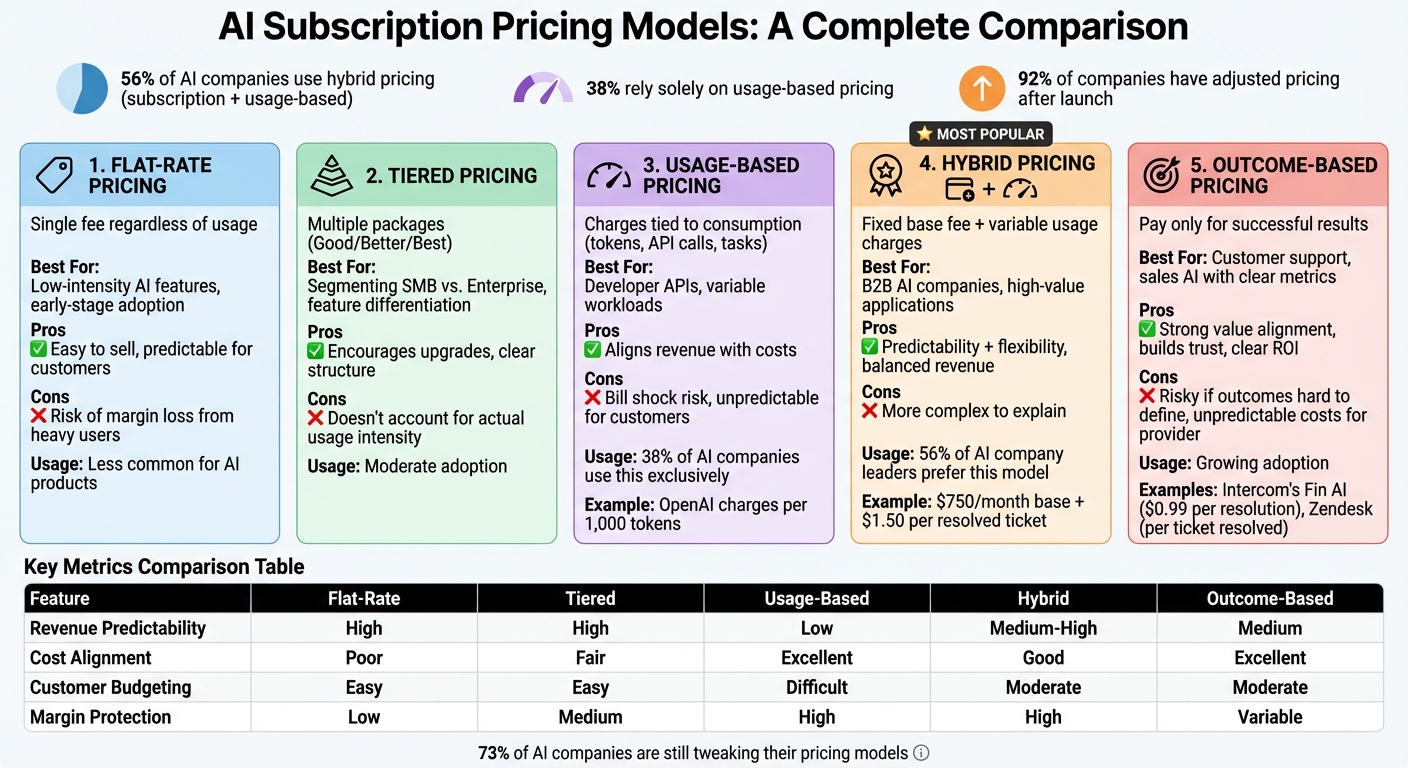
AI Subscription Pricing Models Comparison: Pros, Cons, and Best Use Cases
AI companies today rely on five main pricing models, each tailored to different product structures, customer behaviors, and revenue needs. Choosing the right one depends on factors like operational costs, customer usage patterns, and the importance of predictable revenue as your AI product grows.
Flat-rate pricing charges a single fee regardless of usage. It's straightforward for customers but can strain profits when heavy users drive up GPU costs. Tiered pricing breaks offerings into packages (e.g., Good/Better/Best), letting customers pick based on their needs and budget. This approach provides an upgrade path but doesn’t account for varying usage levels [10]. Usage-based pricing ties costs to consumption - like tokens, API calls, or tasks completed. While this aligns revenue with costs, it can lead to "bill shock" when customers face unexpected charges [7][9].
The most widely used approach is hybrid pricing, favored by 56% of AI company leaders [2]. This combines a fixed subscription fee with variable usage charges, offering predictability with flexibility. On the other hand, 38% of AI companies rely solely on usage-based pricing [2].
Flat-Rate and Tiered Subscriptions
Flat-rate pricing is ideal for low-intensity AI features or early adoption strategies. A single fee per user or account simplifies the sales process and reassures customers with predictable costs. However, this model carries risks. If a small group of users consumes significantly more resources, margins can shrink quickly. To mitigate this, companies often impose internal "fair use" caps or rate limits, even if these aren't publicly disclosed [7][9].
Tiered pricing offers more flexibility by dividing customers into segments, such as SMBs and Enterprises, with each tier unlocking additional features or higher usage limits. This approach encourages upgrades as customer needs grow, but it doesn’t adapt to actual usage intensity, which can limit its effectiveness.
| Model | Best For | Pros | Cons |
|---|---|---|---|
| Flat-Rate | Low-intensity AI features; early-stage adoption | Easy to sell; predictable for customers | Risk of margin loss from heavy users |
| Tiered | Segmenting SMB vs. Enterprise; feature differentiation | Encourages upgrades; clear structure | Doesn't account for actual usage |
Usage-Based and Hybrid Pricing
For more flexibility, usage-based and hybrid pricing models address the variability in customer needs.
Usage-based pricing meters every interaction, such as tokens processed, API calls made, or tasks completed. For example, OpenAI charges per 1,000 tokens [11], while Runway ML’s $12/month plan includes about 50 seconds of AI video generation [1]. This approach aligns revenue with operational costs but can make it difficult for customers to predict their bills, leading to potential revenue swings.
Hybrid pricing has become the go-to model for B2B AI companies [9][7]. It combines a fixed base fee (e.g., $750/month) to cover infrastructure with additional variable charges for high-cost tasks. For instance, AI support bots might charge $1.50 per resolved ticket on top of the base fee [7]. Similarly, CRM providers often add AI-powered features as optional add-ons to their standard per-user fees [7]. This model balances cost control for customers with predictable revenue for businesses, making it a practical solution for AI's unique pricing challenges.
Outcome-Based Pricing
Outcome-based pricing takes a different approach, focusing on results rather than usage. Customers pay only for successful outcomes, such as resolved tickets or qualified leads. For example, Intercom's Fin AI charges $0.99 per resolution [3][12], and Zendesk charges per ticket resolved by AI agents [12]. Instead of billing for tokens or API calls, this model emphasizes measurable business outcomes.
This approach offers buyers a clear return on investment. As Aisling O'Reilly, Head of Pricing at Stripe, explains:
"Outcome-based pricing has been a powerful growth driver for us, as it aligns our success directly with our customers' and focuses our whole team on delivering results for our customers." [5]
However, this model comes with risks. Providers face unpredictable costs, and attributing outcomes can be tricky when multiple tools or manual inputs are involved [12][9]. It works best in areas like sales and support, where success is easier to define. To make this model work, it's essential to establish clear, measurable success metrics that can’t be manipulated [13][9].
How to Design AI Subscription Pricing
Creating effective pricing for AI subscription models starts with pinpointing what customers truly value and then tying that value to a measurable metric you can charge for. A mismatch between operational costs and what customers perceive as valuable often leads to pricing failures. Companies that manage to align these two factors grow 30% faster than those that don’t [14].
Connecting Value Metrics to Pricing Metrics
A value metric is essentially the bridge between what customers care about and what you charge them for. It should be simple to understand, measurable, and linked to both the value customers receive and your operational costs [9][14]. For AI products, value metrics typically fall into four categories:
- Inputs: Examples include seats or users.
- Activities: Think queries or GPU hours.
- Outputs: Such as images or emails generated.
- Outcomes: Successful resolutions or leads achieved [14].
The right metric often depends on whether your AI functions as a Copilot (enhancing human productivity) or an Agent (automating tasks entirely) [11][9]. Copilot models often rely on seat-based pricing since they boost individual productivity. Agents, however, can have highly variable workloads, sometimes ranging from 10 to 100 times the effort per task, which makes workload-based metrics more appropriate [9]. For instance, GitHub Copilot lost $20 per user per month - and up to $80 for heavy users - because seat-based pricing didn’t account for high compute costs [14].
To get started, map your internal cost drivers - like model calls, tokens, or API integrations - to external metrics that closely track those costs and protect your margins [9]. For developer-focused products, infrastructure-based metrics like tokens often work best. For business users, metrics tied to workflows, such as completed tasks or resolutions, align better with how they perceive value [9]. Even if you begin with flat pricing, it’s crucial to track data from the start. Monitor agent runs, token usage, and other metrics so you can transition to usage-based pricing when needed [9].
| Metric Type | Example Unit | Best For | Pros | Cons |
|---|---|---|---|---|
| Input-based | Per Seat/User | Copilots, early-stage products | Easy to understand; predictable for CFOs | High-cost users may erode margins |
| Activity-based | Per Query/Task | Workflow automation, Ops tools | Aligns revenue with compute costs | Harder for customers to predict costs |
| Outcome-based | Per Resolution/Lead | Customer support, Sales AI | Strong value alignment; builds trust | Risky if outcomes are hard to define |
Once you’ve identified a clear value metric, you can use technology to fine-tune your pricing.
Using AI to Optimize Prices
AI pricing strategies are rarely set in stone. In fact, 73% of AI companies are still tweaking their pricing models [6], and 92% of those using usage-based pricing have adjusted rates after launching [2]. AI-powered tools like Pricefx and Zilliant analyze customer behavior, usage trends, and churn risks to recommend better pricing tiers or adjustments. These platforms can even adapt rates in real time or tailor offers for specific customer segments [5].
The golden rule is to align your charge metric (what you bill for) with your value metric (what customers value) [2]. For example, if your customers value time savings but you charge per API call, the disconnect could hurt conversions. Use analytics to model scenarios and predict how pricing changes might affect revenue, customer acquisition, and retention [16]. Stripe’s AI-driven recovery tools, for instance, helped businesses recover over $6.5 billion in revenue in 2024 [15].
To avoid "bill shock", set safeguards. Hard caps can stop usage at 150% of a customer’s commitment, while soft alerts can notify users when they hit 80% or 100% of their quota [9]. These measures protect your margins and maintain customer trust while allowing flexibility for testing and refinement.
Testing and Improving Pricing Models
Testing pricing strategies requires a methodical approach. Start with a clear, testable hypothesis like: "Lowering the price from $50 to $45 will increase monthly revenue by 10%" [15]. Change one variable at a time and ensure your sample size is large enough to yield statistically significant results [15].
Begin with phased rollouts. Test new pricing with a small subset of users to identify potential issues - like billing errors or customer dissatisfaction - before expanding to your full user base [15][16]. Segment your results by customer groups, such as enterprise versus small businesses, to see if a change benefits one segment while negatively affecting another [15]. Key metrics to monitor include churn rate, monthly recurring revenue (MRR), conversion rates, and customer lifetime value (LTV).
Companies that use 3 to 5 different charge models, each contributing at least 10% of revenue, tend to see stronger year-over-year growth and reduced churn [14]. Don’t hesitate to iterate. As Colin Carroll, Pricing and Commercial Excellence at PwC, puts it:
"We're firmly in the adoption foot race, but as consumption usage and value patterns emerge, we would expect the pricing models to continue to evolve." [14]
The more you experiment, the better you’ll understand what your customers value and how much they’re willing to pay for it.
Pricing Patterns That Work for AI Subscriptions
Once you've identified your value metrics, the next step is to choose a pricing model that aligns costs with both usage and perceived value. Effective pricing patterns address specific challenges unique to AI products. Three proven strategies - base subscription plus usage credits, AI features as premium add-ons, and custom enterprise pricing - each cater to different types of AI offerings and customer needs.
Base Subscription Plus Usage Credits
This model combines a flat fee with usage-based credits, offering a balance between predictable revenue and the flexibility to handle variable compute costs. Customers pay a fixed monthly fee, which includes a set amount of credits. Once those credits are used up, they can either pay for overages or purchase additional credits [8][17][18].
Take Runway ML as an example: their $12/month plan includes enough credits for roughly 50 seconds of AI-generated video [1]. This setup works well because the compute costs for video generation can vary significantly. For instance, creating a high-resolution clip might use 50 credits, while a simple text summary might only cost 1 credit. By using credits as a universal currency, Runway ensures that heavy users pay proportionally for their higher "compute tax" [1][18].
This model is particularly effective for developer platforms and AI APIs, where workloads can fluctuate. Browserbase, for example, offers tiered subscriptions with prebundled usage and transparent overage fees [2]. To avoid surprising customers with unexpected bills, consider implementing usage alerts at key thresholds, such as 80%, 100%, and 125% of the included quota [9].
| Feature | Flat-Rate Subscription | Usage-Based (Pay-as-you-go) | Base + Usage Credits (Hybrid) |
|---|---|---|---|
| Revenue Predictability | High | Low | Medium-High |
| Cost Alignment | Poor (High risk with AI) | Excellent | Good |
| Customer Budgeting | Easy | Difficult | Moderate |
| Best For | Low-compute, stable tools | Developer APIs, variable loads | High-value AI apps with power users |
AI Features as Premium Add-Ons
When AI features provide significant value to a subset of users, offering them as premium add-ons can be a smart move. This approach lets you monetize advanced features without raising prices for all customers, keeping your product accessible to low-usage users. For instance, a CRM platform might charge $49 per user per month for its base plan, with an optional "AI Sales Copilot" add-on for an extra $39 per user per month [7].
In 2024, Canva increased its Teams pricing by up to 300%, largely due to the expansion of its Magic Studio AI tools [1]. Instead of bundling these AI tools into the base plan, Canva positioned them as a premium upgrade. This strategy protects margins while giving customers the choice to pay for advanced capabilities only if they find them valuable.
"AI power now sits behind the paywall. AI isn't a freemium land grab. It's a high-cost infrastructure business." - Alice Muir Kocourková, RevenueCat [1]
This model works best for productivity tools, CRMs, or platforms where AI enhances workflows rather than being the core offering. Since AI often comes with high variable costs, it's wise to include "fair use" policies or usage caps to prevent heavy users from becoming unprofitable [7].
Custom Enterprise Pricing
For large organizations with complex needs, custom enterprise pricing offers the flexibility to meet their specific requirements. These deals often combine components like seat licenses, committed usage blocks, and sometimes performance-based bonuses. For example, a typical structure might include an annual platform fee of $120,000, which covers up to 2 million tasks, with pre-negotiated rates for any additional usage [9].
Intercom has adopted an outcome-based pricing model for its AI agent "Fin", charging a fixed fee for each support ticket successfully resolved [2][13]. This approach shifts some risk to the provider but ensures that pricing aligns directly with the customer's return on investment. As Aisling O'Reilly, Head of Pricing, puts it:
"Outcome-based pricing has been a powerful growth driver for us, as it aligns our success directly with our customers' and focuses our whole team on delivering results for our customers." [5]
For enterprise-level agreements, it's essential to use straightforward metrics - like "tasks" or "resolutions" - instead of overly technical jargon [7]. Additionally, you can include clauses that account for rising third-party AI infrastructure costs, ensuring long-term sustainability [7]. When transitioning existing customers to new AI-driven pricing, consider offering a grace period or "grandfathered" rates for one renewal cycle to ease the shift [7].
Tools for Managing AI Subscription Pricing
Getting your pricing model right is one thing - actually putting it into action is a whole different ballgame. The right billing platform can take a huge load off your shoulders by handling tricky tasks like real-time metering and automated credit top-ups.
Billing and Monetization Platforms
Stripe Billing is a favorite among AI companies, with a whopping 78% of the Forbes AI 50 relying on it for their financial infrastructure [19]. Why? It supports various pricing models, including usage-based, tiered, and hybrid options. Its "Advanced Usage-Based Billing" feature (currently in private preview) goes a step further by offering real-time credit tracking and advanced metering capabilities [17]. OpenAI, for example, chose Stripe because of its flexibility, speed, and high standards. Plus, it supports up to 100 million usage events per month, making it a powerhouse for scaling [19].
Chargebee is another strong contender, simplifying credit-based and capacity-based pricing models. It handles entitlement enforcement and allows seamless mid-cycle upgrades [3]. On the other hand, Orb caters specifically to AI agents with its "prepaid credits" ledger system. It offers real-time usage insights and automatic credit top-ups, making it a great choice for AI-driven businesses [20].
These platforms use meters to track specific AI-related activities like API calls, tokens processed, or GPU hours consumed. They also provide flexible aggregation methods - whether it's summing up tokens, counting requests, or pinpointing peak usage [17]. This separation of raw usage data from pricing logic gives you the freedom to test new pricing strategies without altering your product code [20]. And if you’re looking to fine-tune your revenue approach even further, specialized pricing software can help.
AI-Powered Pricing Software
Specialized pricing tools take things up a notch by analyzing customer segments. They can identify which groups are willing to pay more and which might churn if prices change [15]. By considering factors like customer region, usage tier, or feature type, these tools help you design tailored pricing strategies for different segments. The real magic lies in their ability to continuously test and refine pricing. Companies that adjusted their pricing in 2022 saw a median 14% boost in net dollar retention [21].
These tools also support cohort rollouts, allowing you to test new pricing models with a subset of customers or specific regions before a full-scale launch. Plus, they let you manage multiple pricing versions simultaneously - keeping legacy customers on their existing plans while offering updated structures to new sign-ups [17].
Using AI Agents for Faster Implementation
AI coding agents are speeding up how businesses build and tweak their pricing systems. Tools like ClackyAI make it easy for developers to integrate billing systems and experiment with pricing without starting from scratch. For example, the Stripe Agent Toolkit allows AI agents to handle billing tasks through natural language prompts - things like creating prices, provisioning customers, or adjusting subscriptions automatically [22]. This kind of efficiency is crucial, especially since 92% of companies charging for AI services have already adjusted their pricing at least once [2].
Take Midjourney, for instance. When they integrated Stripe, they said:
"It accelerated our time to market, reduced our costs, and just made our lives a whole lot easier. It let us focus on finding product-market fit, not building billing infrastructure" [19].
With these tools, businesses can focus on what really matters - delivering value to their customers - while leaving the heavy lifting of billing and pricing to the pros.
Conclusion: Building Scalable AI Pricing
AI subscription pricing is not a "set it and forget it" game. In fact, 92% of companies charging for AI usage have made adjustments to their pricing after launch. These tweaks aren’t just for show - they deliver results, with regular pricing reviews leading to a median 14% boost in net dollar retention [2][21]. Think of pricing as a product in itself: it needs constant testing and refinement, driven by real customer insights.
The standout AI companies build their pricing around value metrics rather than focusing solely on usage metrics. Instead of charging per token or API call, they tie pricing to outcomes that truly matter to their customers - like resolved support tickets or completed workflows. This approach not only makes pricing easier for customers to justify but also safeguards margins. Businesses using this model often experience stronger growth because their success is directly tied to customer results [2][5][7]. It’s a win-win strategy that lays the groundwork for scalable pricing models.
Flexibility is key when dealing with varying usage patterns. Today, 56% of AI company leaders rely on hybrid pricing models that mix subscription fees with usage-based charges [2]. This shift away from rigid, one-size-fits-all structures allows companies to cater to both casual users and heavy users without compromising profitability. Tools like usage thresholds, pre-paid credits, and automated alerts can help manage costs while supporting customer growth [2][7].
To execute these strategies effectively, your billing infrastructure needs to be up to the task. Platforms like Stripe and Chargebee simplify real-time metering and credit tracking, while AI coding tools like ClackyAI streamline implementation. These solutions let you experiment with new pricing models without overhauling your entire system - keeping your business agile and responsive.
Looking ahead, 90% of mid-sized SaaS companies anticipate significant changes to their business models due to AI within the coming year [4]. In an industry defined by rapid evolution, the companies that thrive will be the ones that stay adaptable - continuously refining their pricing based on customer behavior and sound economics. As AI technology advances, so must your pricing strategy. Stay nimble and let your pricing evolve right alongside the innovations you're delivering.
FAQs
How do AI companies decide between flat-rate and usage-based pricing models?
AI companies are increasingly turning to a hybrid pricing model to find the right balance between consistency and adaptability. This setup combines a fixed subscription fee for essential services with additional charges based on actual usage. The subscription fee provides users with predictable costs, while the usage-based charges ensure pricing reflects variables like computational power or specific outcomes.
This method is especially effective for subscription-based products, offering a mix of clarity and adaptability. Customers benefit from a stable base cost while only paying extra when their usage exceeds standard levels. It’s a practical solution for AI tools like ClackyAI, where computational demands can vary significantly depending on how users engage with the platform.
What are the advantages of using outcome-based pricing for AI subscription services?
Outcome-based pricing links the cost of AI subscriptions to the actual results customers achieve. This strategy creates a shared focus between providers and customers, narrowing the gap between perceived value and delivered results while fostering trust.
By basing pricing on measurable outcomes, companies can clearly showcase the real-world impact of their AI solutions. This approach not only boosts customer satisfaction and loyalty but also promotes lasting growth by ensuring pricing is transparent and directly tied to customer success.
How can AI tools improve real-time pricing for subscription services?
AI-powered pricing tools take the guesswork out of subscription pricing by analyzing real-time data like market trends, competitor pricing, customer behavior, and usage patterns. Instead of sticking to outdated static pricing models, these tools enable dynamic adjustments, keeping prices competitive and responsive to shifting conditions.
With machine learning, businesses can dive deeper into customer segmentation and predict churn with precision. This allows for pricing tailored to the value each user derives, ensuring a better fit for both the customer and the company. AI also makes it easier to test pricing strategies quickly and roll out personalized offers, paving the way for smarter decisions and increased revenue. For instance, tools like ClackyAI simplify the process of creating custom pricing systems by building adaptive models that learn and refine pricing strategies in real time.