







Best Practices for AI-Powered Ad Optimization
Running ads without AI is outdated and costly. AI-powered tools optimize targeting, creatives, and budgets in real time, helping brands achieve better results while saving money. For example, Citibanamex increased credit card bookings by 27% and reduced costs by 7% using AI-driven strategies. Here's what makes AI essential for modern advertising:
- Solves Common Issues: AI tackles ad fatigue, poor targeting, wasted budgets, and privacy challenges by analyzing millions of signals instantly.
- Boosts Performance: AI improves conversion value by 25% on average and reduces costs for businesses like the Boy Scouts of America, who doubled revenue with AI-driven campaigns.
- Automates Workflows: Tools like Performance Max streamline ad management across platforms, saving time and improving outcomes.
To get started, focus on clean data, use first-party information, and adopt automated tools for bidding and creative testing. AI isn't just a tool - it's the key to staying competitive in today's fast-changing ad landscape.
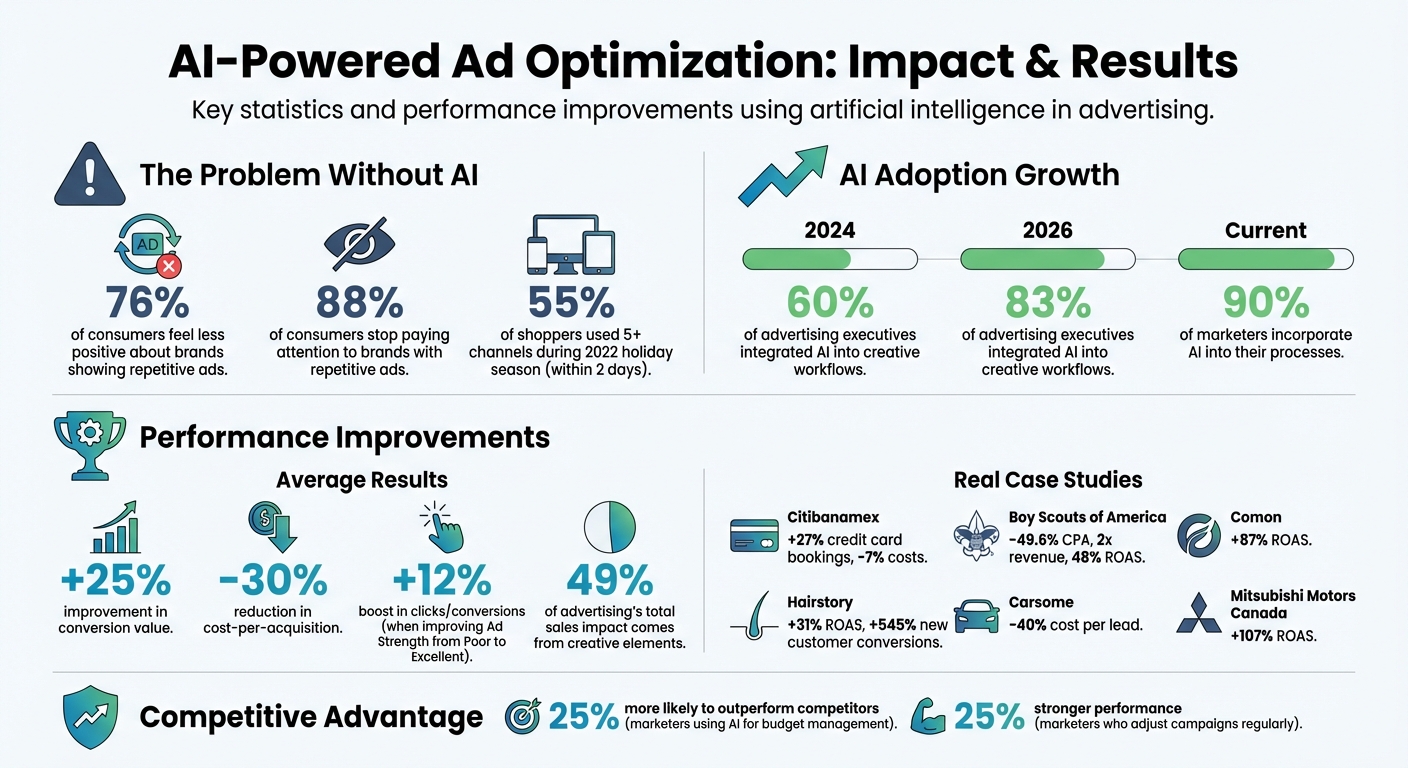
AI-Powered Ad Optimization: Key Statistics and Performance Improvements
From Curiosity to Conversions: Mastering AI-Driven Campaigns
Common Problems in Ad Optimization Without AI
Running ad campaigns manually often creates inefficiencies that waste money and limit results. Without AI, advertisers have to rely on outdated inputs and delayed feedback, leaving them unable to keep up with fast-changing market trends. The outcome? Overspending, missed chances, and underperforming campaigns. Let’s break down how these issues show up in key areas of ad optimization.
Ad Fatigue and Dropping Engagement
Seeing the same ad over and over again can make people tune out. This phenomenon, known as "ad blindness", happens when repetitive ads fail to hold attention. In fact, 76% of consumers feel less positive about brands that repeatedly show the same ads, and 88% admit they stop paying attention to those brands altogether [9]. Platforms like Meta and TikTok notice this drop in engagement and penalize stale ads by reducing their reach, which forces advertisers to spend more for the same visibility [9][10][12].
The problem is especially bad on platforms like Instagram and TikTok, where ad fatigue can set in within just a few days. Meta, for example, identifies creative fatigue when the cost-per-result doubles or when the click-through rate (CTR) drops 20% below its seven-day average [11]. Without AI to monitor and adjust for these patterns, marketers often realize there’s an issue only after wasting a significant portion of their budget [10].
Poor Audience Targeting
Manual targeting just doesn’t cut it in today’s ad environments. It can’t process the massive number of signals - like device type, language, time of day, or user intent - that influence every ad auction [13][15]. Sticking to static keywords or pre-set audience segments means advertisers miss out on new search trends and shifts in consumer behavior [1].
A great example of this is the Boy Scouts of America. After switching to AI-driven Google Performance Max in 2024, they reduced their cost per acquisition (CPA) by 49.6% and doubled their revenue in just one year [13]. This shows how AI can adapt to real-time changes that manual processes simply can’t handle.
Wasted Ad Spend and Budget Problems
Manual bidding is another area where inefficiencies pile up. Without the ability to optimize in real time, advertisers either overpay for clicks that don’t convert or miss out on valuable opportunities altogether [15]. AI-powered tools, on the other hand, allow for smarter, data-driven budget allocation. In fact, marketers who use AI for budget management are 25% more likely to outperform their competitors [4].
Managing Ads Across Multiple Platforms
Running campaigns across platforms like Google, Meta, and TikTok manually creates silos that make it hard to see the bigger picture. During the 2022 holiday season, 55% of shoppers used five or more channels within just two days [4]. Yet, many advertisers manage each platform separately, leading to disconnected strategies and missed opportunities to shift budgets effectively [14].
This fragmented approach also complicates scaling. When data is scattered across platforms, it’s nearly impossible to get a clear view of the customer journey or adjust spending based on where conversions are happening [13]. Additionally, managing multiple platforms manually makes it harder to comply with privacy regulations.
Privacy Rules and Tracking Limitations
Privacy laws and scattered data sources make it tough to get the insights advertisers need. Without integrated data from CRMs, websites, and apps, marketers are left with an incomplete view of customer behavior [14]. Manual analysis rarely identifies patterns, such as which customers are most likely to convert, and this means missed opportunities [13][16]. AI can bridge these gaps by predicting customer behavior and assigning value to different steps in the sales funnel, something manual processes struggle to achieve [8].
How AI Solves Ad Optimization Problems
AI has reshaped ad optimization by processing an immense amount of signals in milliseconds, allowing it to fine-tune targeting, creatives, and budgets in real time. Where human marketers might adjust bids a few times a day based on general trends, AI digs deeper, analyzing factors like device type, location, time of day, and browsing behavior for each individual ad impression [21]. This auction-time optimization focuses on tailoring bids to specific opportunities, moving beyond broad audience categories. For instance, as of early 2026, 83% of advertising executives reported integrating AI into their creative workflows, a rise from 60% in 2024 [19].
AI-Powered Targeting and Audience Segmentation
AI excels at audience targeting by using signals such as first-party data, Customer Match lists, and custom audience segments. These inputs help machine learning models pinpoint the customers most likely to convert [4]. One standout feature is the discovery of "Optimized" segments - new, high-value audience groups identified by AI that might otherwise remain hidden.
Value-based bidding takes this a step further by aligning ad strategies with specific business goals. Instead of treating all conversions equally, AI prioritizes users with higher predicted lifetime value or better profit potential [2].
AI-Generated Ad Creatives
To address ad fatigue, AI uses computer vision to break down visual assets into components like color schemes, typography, object placement, and even facial expressions. This helps identify which design elements drive better performance [17]. Unlike traditional A/B testing, this method evaluates each creative component individually.
Creative scoring models predict how well ads will perform before they even go live by analyzing factors like visual appeal, brand consistency, and historical data. Advertisers who improve their Ad Strength from "Poor" to "Excellent" with AI-driven recommendations typically see a 12% boost in clicks and conversions [3]. Dynamic Creative Optimization (DCO) further customizes headlines, visuals, and messaging in real time for different audience segments [18]. Considering that creative elements account for 49% of advertising’s total sales impact [3], AI also simplifies content reformatting, such as adapting videos for platforms like YouTube Shorts or Instagram Reels [3].
Automated Bidding and Budget Distribution
AI-powered bidding systems determine auction prices in milliseconds by analyzing millions of data points to predict both the clearing price and the likelihood of conversion [21]. This approach can cut cost-per-acquisition by as much as 30% [21].
Budget management becomes more effective when AI monitors campaigns across multiple platforms. For example, Carsome used AI to dynamically shift budgets, reducing cost per lead by 40%. Switching from Target CPA to Target ROAS led to 14% more conversion value and, in one instance, a 66% increase in app installs while cutting costs by 32% [20][22].
"Pixis AI works 24/7 to monitor and shift budgets from non-performing to performing campaigns in real time" [20]
These automated systems ensure campaigns are continuously optimized.
Real-Time Performance Monitoring
AI analytics provide constant feedback, using auction data to refine future bidding strategies [21].
"Analyzing millions of data points in real time, AI turns programmatic bidding from a reactive process into a predictive one" - Diego Pineda, Editorial Content Manager at StackAdapt [21]
Machine learning tracks key performance metrics and flags declining engagement, triggering creative updates when needed [17]. Additionally, AI-driven incrementality testing ensures that automated bids lead to new conversions instead of just reallocating credit from organic traffic.
sbb-itb-c336128
Practical Steps for Using AI in Ad Optimization
To make the most of AI in your ad campaigns, start with accurate tracking. Use tools like Google Tag Manager for sitewide tagging and enable enhanced conversions. These steps ensure AI has the clean data it needs to make informed decisions [4]. Without proper tracking, even the smartest AI tools can fall short. Here’s how to maximize AI’s potential in your campaigns.
Use First-Party Data to Improve AI Performance
First-party data - like CRM information and website interactions - plays a key role in guiding AI. It helps identify your most valuable customers. By uploading hashed Customer Match lists, you provide audience signals that speed up the AI's learning process [5]. A great example of this is Mitsubishi Motors Canada. They used value-based bidding, incorporating online data to reflect offline sales, and saw their ROAS jump by 107% [6].
"Innovating on how we bid using conversion values helps us reach customers more effectively and turn potential into actual results" [6]
Instead of treating all conversions the same, assign monetary values to different actions. This approach ensures AI optimizes for outcomes that align with your business goals [5][6].
Use Automated Campaign Management Tools
Automation simplifies campaign management. Tools like Performance Max can handle bids, targeting, and creatives across platforms like Search, YouTube, Display, and even Google Maps - all from a single campaign. Adding video assets to these campaigns can increase total conversions by 12% [4].
Take Hairstory, a US-based hair care retailer, as an example. Partnering with the agency Better & Stronger, they implemented Performance Max with a focus on acquiring new customers. The result? A 31% boost in ROAS and a 545% increase in new customer conversions in early 2023 [4].
To get the most out of these tools, include a variety of text, image, and video assets. AI will test combinations to find what resonates best with different audiences [5].
Review Campaign Performance Regularly
AI needs time to learn, so let campaigns run for at least six weeks before making big changes [7]. After this period, conduct quarterly reviews using tools like Performance Planner to fine-tune budgets and bidding strategies for better conversion value [4].
Check your Ad Strength metric consistently. Aim for an "Excellent" rating by diversifying headlines and descriptions. Even small tweaks here can lead to a 12% increase in clicks and conversions [2]. Marketers who adjust campaigns regularly report 25% stronger performance [4]. Routine reviews help ensure your AI-driven campaigns stay aligned with your optimization goals.
How ClackyAI Supports Ad Optimization Workflows
Managing ads manually or juggling fragmented systems can slow down progress. ClackyAI steps in with a development environment designed specifically for creating custom ad tech tools. While many AI tools focus on campaign execution, building the infrastructure behind ad operations often takes a lot of time and effort. That’s where ClackyAI shines - helping teams quickly create and deploy the software needed to optimize ad workflows.
Building Ad Tech Tools Faster
Ad optimization today relies on real-time data from multiple platforms. ClackyAI simplifies the process of developing custom ad tech tools by offering a unified development environment. Thanks to its Universal Connectors, manual API coding becomes unnecessary, making integrations more efficient and less prone to breaking when platforms update their systems [23].
For businesses running campaigns across Google Ads, Meta, LinkedIn, and Microsoft, ClackyAI’s codebase awareness makes it easier to manage comprehensive PPC workflows from one interface [23]. Teams can easily compare performance across channels and automatically adjust budgets - tasks that would typically require juggling multiple scripts. This streamlined approach helps businesses build and deploy tailored solutions faster.
Deploying Custom Solutions Quickly
Once integrations are in place, ClackyAI speeds up the deployment of custom ad tools. In the fast-paced world of advertising, quick adjustments are crucial. ClackyAI enables teams to roll out tools for specific campaign needs in days rather than months. Whether it’s a dashboard to monitor return on ad spend (ROAS) across platforms or a tool that links your CRM data with bidding systems, ClackyAI handles everything from backend logic to creating the user interface.
Real-time collaboration features make it easy to iterate quickly. If a campaign strategy shifts, teams can update their tools immediately without waiting on external developers. This flexibility ensures businesses can adapt to market changes and keep their ad performance optimized.
Conclusion
Managing ad optimization manually has become a thing of the past. With consumers engaging across five or more channels during peak shopping seasons [4] and creative assets accounting for 49% of advertising impact [2], AI tools are no longer just helpful - they’re essential. These tools allow advertisers to shift from reactive adjustments to real-time, predictive optimization, making them a critical component for staying ahead in a competitive landscape.
The success stories speak for themselves. Citibanamex boosted credit card bookings by 27% while cutting costs by 7% with AI-powered value-based bidding [8]. Hairstory saw a staggering 545% jump in new customer conversions by using AI for audience targeting [4]. Boy Scouts of America doubled their revenue and achieved a 48% return on ad spend after embracing AI-driven campaigns [13]. These examples highlight actionable steps you can take: if creative production is slowing you down, use AI tools for automated creative testing. If managing budgets feels overwhelming, turn to automated bidding systems. Start by strengthening your foundation with first-party data, integrating AI tools into your workflows, and embracing a mindset of testing and learning before scaling up.
With 90% of marketers already incorporating AI into their processes [13], the question isn’t whether to adopt AI - it’s how quickly you can make it part of your strategy. Take a close look at your current operations and identify the AI solutions that can address your biggest challenges. Those who approach AI as more than just another tool, but as a strategic partner, will gain a significant advantage. Start today by pinpointing your biggest bottleneck and applying the right AI solution - because chances are, your competitors already have.
FAQs
How can AI help prevent ad fatigue and boost audience engagement?
AI plays a key role in tackling ad fatigue and boosting engagement by closely monitoring audience behavior. It identifies early warning signs like a drop in click-through rates (CTR) or a rise in cost-per-acquisition (CPA). When these trends surface, AI can either suggest or automatically implement changes to ad creatives, targeting methods, or formats. This ensures your content stays fresh and aligned with audience preferences.
On top of that, AI simplifies A/B testing and manages creative rotation efficiently. It prioritizes ads that perform well and tweaks or replaces those that don't. This strategy not only keeps campaigns effective for longer but also minimizes wasted ad spend. The result? A more engaged audience, improved campaign performance, and a better return on investment (ROI).
Why is first-party data important for AI-driven ad optimization?
First-party data plays a key role in AI-powered ad optimization because it offers direct and trustworthy insights into your audience's behaviors and preferences. This kind of data enables AI tools to craft highly targeted and personalized ad campaigns, boosting engagement and driving better results.
Using first-party data also helps businesses minimize dependence on third-party sources, giving them greater control over customer information. More importantly, it allows for the creation of advertising strategies that are specifically designed to meet the unique needs of their audience.
How can businesses effectively use AI tools to optimize their ad campaigns?
To get the most out of AI tools for ad optimization, start by preparing your data and creative assets. Clean, well-organized data and visually appealing, engaging creative elements are key to enabling accurate analysis and better campaign performance.
Try using AI-powered features like automated campaign options or creative analysis tools. Begin with smaller experiments to monitor performance, then expand once you see positive results. Regular testing and adjustments are crucial for improving outcomes over time.
If your business is looking to develop custom AI solutions, platforms like ClackyAI can simplify the process. They provide the core tools needed to create and refine AI-driven products efficiently.