







Case Study: Validating a Micro-SaaS Idea
Most SaaS ideas fail because they don’t solve real problems. This case study shows how David Wilson validated his Micro-SaaS concept - an invoicing tool for freelance graphic designers - before writing any production code. He followed a step-by-step process to confirm demand, secure paying customers, and build a minimal viable product (MVP) in just weeks using AI tools.
Key takeaways:
- Problem discovery: Found a pain point (manual invoicing frustrations) through Reddit and LinkedIn conversations.
- Validation: Tested demand with a landing page and secured 3 paying beta users within 48 hours.
- MVP development: Used AI tools like ClackyAI to build a functional product in under two weeks for $75.
- Results: Landed paying customers quickly and refined the product through direct user feedback.
Wilson’s journey highlights the importance of validating your idea, focusing on solving a specific problem, and using tools to save time and effort.
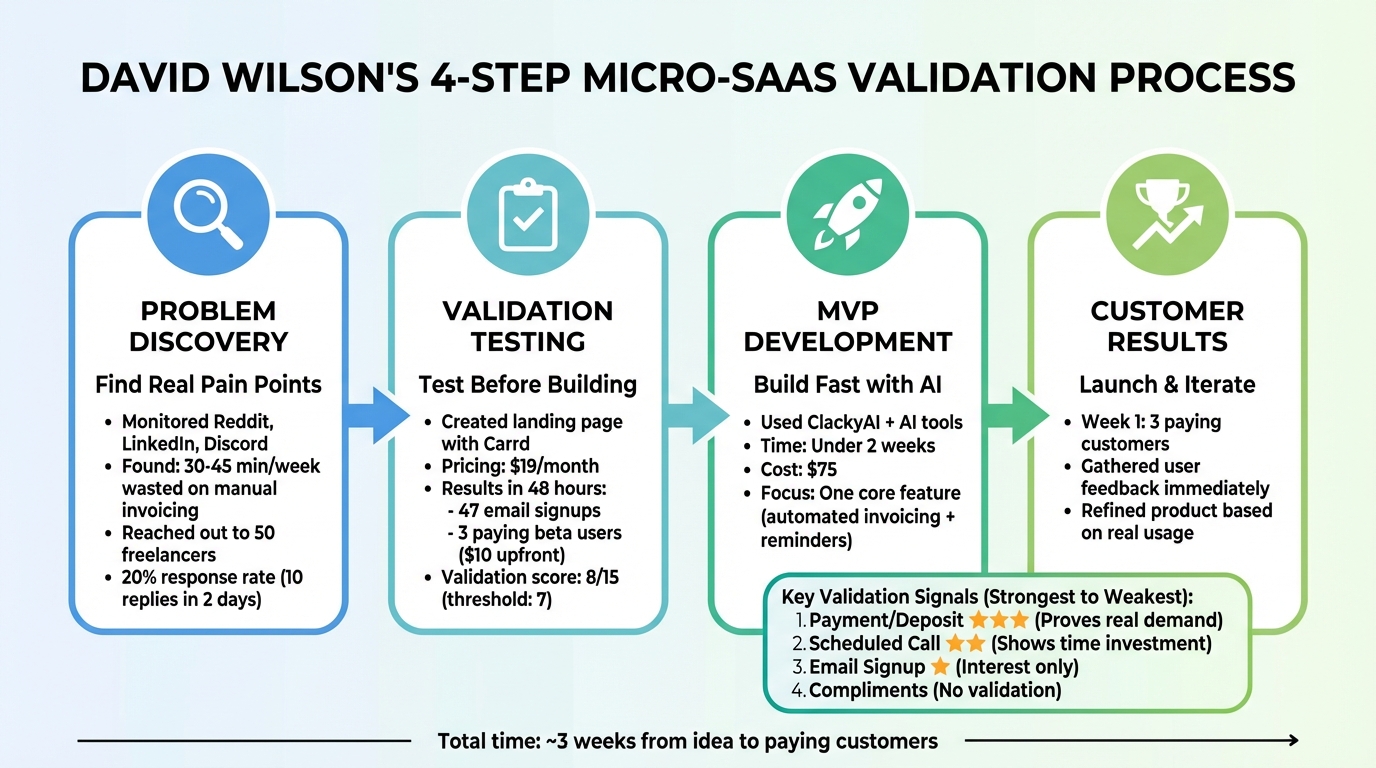
4-Step Micro-SaaS Validation Process: From Problem Discovery to Paying Customers
Finding and Confirming the Problem
How the Problem Was Discovered
Back in April 2025, David Wilson stumbled upon a recurring issue while browsing r/freelance. Freelance graphic designers were venting about how they spent 30–45 minutes every week on manual invoicing, which often led to frustrating payment delays [2]. This wasn’t an isolated complaint, either. Wilson noticed similar frustrations popping up across various platforms - Discord channels for creatives, YouTube tutorials about invoicing in Google Sheets, and more.
What stood out was the reliance on makeshift solutions. Designers were piecing together workflows using Notion templates, Airtable bases, and spreadsheets - essentially duct-taping systems to get by. For Wilson, this was a flashing neon sign that a Micro-SaaS opportunity might be hiding in plain sight. As SaaS strategist Swarnendu De aptly puts it:
If someone has duct-taped a system together, there's a product hidden inside it [4].
Confirming the Problem is Real
To see if this problem was more than just online chatter, Wilson dug deeper. He monitored platforms like Twitter, Slack, and niche communities, searching for terms like "frustrated with invoicing" and "alternative to FreshBooks" [3]. He also analyzed 1-star reviews on G2 and Capterra for existing invoicing tools, which revealed a common thread: complaints about steep pricing, overly complex interfaces, and a lack of features tailored specifically for freelancers [1][5].
Taking it a step further, Wilson reached out to 50 freelance designers on LinkedIn to ask about their invoicing workflows. Within two days, 10 of them replied - a solid 20% response rate that suggested genuine interest [3]. These non-pitch conversations revealed that manual invoicing wasn’t just a minor inconvenience. It typically ate up about 45 minutes each week and often resulted in overlooked follow-ups for overdue payments. This confirmed that the pain point was very real and worth addressing. Armed with these insights, Wilson began crafting a testable hypothesis.
Writing the Hypothesis
Wilson’s next step was to frame a clear, actionable hypothesis: "If I offer an automated invoicing tool for freelance graphic designers, at least 25 professionals will sign up for early access within 10 days" [4]. This hypothesis zeroed in on the target audience, addressed their invoicing struggles, and set a measurable benchmark.
To further validate the idea, Wilson used a simple scorecard to evaluate three key factors - Pain Intensity, Urgency, and Willingness to Pay. The concept scored 8 out of 15, comfortably surpassing the 7-point threshold recommended for pursuing an idea [5]. With a solid hypothesis and validation in hand, Wilson was ready to gauge demand - without writing a single line of code.
sbb-itb-c336128
Designing and Testing the Solution Concept
Creating the Solution Concept
Once Wilson had a clear understanding of the problem, he focused on turning his insights into a practical solution. Instead of cramming in multiple features, he zeroed in on a single goal: "Freelance graphic designers can't track invoices and deadlines in one interface" [2]. This sharp focus allowed him to define the app's core function - automated invoicing with payment reminders - and ignore unnecessary distractions.
To bring his idea to life, Wilson used Figma to create detailed mockups that illustrated how the app would look and function, all without writing a single line of code [1]. These prototypes included screens for creating invoices, monitoring payment statuses, and sending automatic reminders. By presenting these visuals, he gave potential users a chance to interact with a concept that felt real and tangible.
Testing Before Building
Wilson then tested his idea using a "Fake Door" approach [7]. He built a simple landing page with Carrd, showcasing his mockups alongside a clear pitch: "Stop chasing late payments." The page included real pricing at $19/month and a prominent "Get Started" button. However, clicking the button revealed that the product was still in early access and required manual onboarding.
The results came quickly - within 48 hours, Wilson had 47 email signups and 3 beta testers who even paid $10 upfront [2]. As Shayan, founder of UserJot, wisely notes:
The goal isn't to validate that a problem exists. The goal is to validate that you can profitably solve it. [7]
| Validation Signal | Strength | What It Proves |
|---|---|---|
| Payment/Deposit | Strongest | Confirms real demand as users commit money [7][5] |
| Scheduled Call | Strong | Shows users are willing to invest their time in the problem [2][5] |
| Email Signup | Weak | Indicates interest but no financial commitment [7] |
| Compliments | None | Positive feedback alone doesn't pay the bills [4][5] |
Getting Traffic and Feedback
To attract users to his landing page, Wilson shared his mockups in the same spaces where he had identified the problem. This included communities like r/freelance, creative-focused Discord channels, and LinkedIn groups [3]. He also sent 50 personalized LinkedIn messages, achieving a 20% response rate within two days [5].
Wilson didn't stop there. He conducted 5–7 one-on-one interviews to better understand how potential users described their invoicing frustrations. These conversations uncovered emotional pain points such as "I hate chasing clients for money" and "I feel unprofessional using Google Sheets." These insights proved invaluable for crafting marketing messages that resonated with his audience. Armed with this feedback and early traction, Wilson was ready to take the next step: building his MVP.
Building the MVP
Deciding What to Build
Wilson zeroed in on automating invoicing and payment reminders, sticking to what he called the "one annoying task" rule: tackle the single most frustrating part of the user's workflow. This laser focus helped him avoid distractions and stay true to his goal.
To decide what features were essential, Wilson revisited his validation research. He replaced makeshift systems with a simple, streamlined process: create an invoice, track payment status, and send automatic reminders. Anything outside this core functionality was saved for later, to be added only if paying users showed demand.
With a clear plan in place, Wilson leaned on AI tools to speed up the development process.
Using AI Tools to Build Faster
Wilson turned to tools like ClackyAI and similar AI coding platforms to build his MVP in less than two weeks, spending just $75. These tools handled everything from generating the user interface to setting up backend logic, databases, and payment integrations [9]. Thanks to ClackyAI’s full-stack capabilities, Wilson was able to transform his idea into a working product without needing to write extensive code.
This approach isn’t unique to Wilson. In March 2025, another founder, Sakky B, used Cursor (Claude 3.5 Sonnet) and Supabase to create vehicleexpirytracker.com - a B2B SaaS tool for managing UK commercial vehicle compliance. Despite having no coding experience, Sakky automated the entire development process, including Stripe payment integrations and API setups, in under two weeks [9].
This rapid development process allowed both founders to quickly move on to testing their products in the market.
Testing with Paying Users
Wilson built on his earlier validation efforts by immediately converting interest into paying customers. He launched with a core pricing plan of $19/month and used tools like Crisp.io and Hotjar to gather feedback, monitor user behavior, and refine his pricing strategy based on real-world responses [8][9].
Another example of this approach comes from Farez, the founder of ClarifyPDF. When he launched his AI-powered PDF tool in June 2024, he initially priced it at $4.99 per PDF. After reducing the price to $0.99, he doubled his customer base. While revenue stayed the same, the increase in users provided him with far more feedback. As Farez explained:
"In the early stages, user feedback is more valuable than revenue. I halved my price and got double the number of customers. Same revenue, but more user feedback." [8]
Wilson adopted a similar mindset, focusing on attracting more users over maximizing early profits. Within the first week, he gathered invaluable feature requests from his initial customers. He also used automated follow-up emails to reach out to users who signed up but didn’t convert, asking them for honest feedback about what stopped them from continuing [8][5]. This direct feedback loop helped shape his next iteration, proving that his MVP wasn’t just functional - it addressed a problem people were willing to pay to solve.
Results and What Comes Next
Validation Results
After launching his MVP, Wilson closely monitored how it performed in the real world. The results were clear: within just one week, he landed three paying customers. Earlier tests had already shown strong interest, with proactive early-access requests rolling in[2]. These outcomes confirmed Wilson's belief that a specialized invoicing solution could attract genuine investment.
The validation process hit all the right notes. Wilson tackled critical factors: he pinpointed an urgent pain point (freelancers losing money due to late payments), saw that users were keen enough to request invoices before the product was even fully built, and successfully reached his target audience through Reddit communities[5]. His idea passed the validation test with flying colors.
What Was Learned
One key takeaway for Wilson was that pricing plays a big role in attracting the right users. By setting strategic pricing, he drew in serious freelancers while filtering out less committed ones. This aligns with lessons from Farez and ClarifyPDF, where halving the price per PDF doubled the customer base without impacting overall revenue[10].
Another major insight was that speed beats perfection. Using AI tools like ClackyAI, Wilson built his MVP quickly, avoiding the common trap of over-engineering. Instead of aiming for a flawless product, he focused on delivering a functional solution to a real problem. This approach saved time and avoided missteps like those experienced by Elizaveta Shcherbina with her Telegram bot, Blizhe. Despite achieving 100% user growth in just 12 days through SEO, the bot failed to generate sales because its value proposition wasn’t clear[6]. Wilson’s focus on solving a validated pain point ensured he avoided similar challenges. His experience highlights the importance of quick, purposeful action in building Micro-SaaS products.
Validation Principles You Can Use
Wilson’s journey offers three key principles for aspiring founders:
- Start by understanding the problem. Wilson spent time in Reddit communities, listening to freelancers’ invoicing struggles before writing a single line of code.
- Look for clear purchase signals. Don’t commit fully until you see real buying interest. A good benchmark is securing at least 10 paying users[5].
-
Leverage AI for speed, not shortcuts. Tools like ClackyAI can help accelerate development, but genuine validation still requires talking to real users. As Income AIcademy wisely puts it:
Compliments don’t pay Stripe fees.[5]
How to know if your SaaS idea is bad (in 5 days)
FAQs
How did David Wilson validate the demand for his Micro-SaaS idea before building it?
David Wilson approached his Micro-SaaS idea with careful planning to ensure there was genuine demand before diving into development. He began by zeroing in on a specific niche and identifying a clear problem that needed a solution. To validate his concept, he set up a basic landing page that explained the idea and included a "Register Interest" button to collect email addresses.
To attract potential users, he used affordable ads and reached out to relevant communities where his target audience was active. By keeping an eye on sign-ups and having casual conversations with those who showed interest, he was able to gather insightful feedback. This combination of interest sign-ups and user engagement gave him confidence in the demand for his idea - all without writing a single line of code.
How did AI tools help build the MVP quickly and affordably?
AI tools have completely reshaped the way micro-SaaS ideas are turned into working MVPs, slashing development time to just a few days and keeping costs impressively low. Using advanced AI coding assistants like ChatGPT-5, Claude, Replit AI, along with platforms like V0.dev and Cursor, the founder managed to automate core tasks such as backend logic, frontend components, UI mockups, database creation, API setup, and even basic testing. What would normally take weeks of effort was condensed into a matter of days, with the only expense being a small cloud-hosting fee.
But the impact of AI didn’t stop at coding. AI tools also sped up market validation and design. Research tools powered by AI quickly sifted through forums, social media, and keyword trends to confirm there was demand for the product. Meanwhile, AI-driven design platforms crafted professional landing pages and compelling copy in just minutes. This level of automation removed the need for a full development or design team, allowing the MVP to launch as a polished, user-ready product. Tools like ClackyAI, which seamlessly integrate code generation with deployment-ready solutions, showcase how AI can function as a full-stack partner in building modern micro-SaaS platforms.
How did David Wilson gather feedback to refine his Micro-SaaS idea?
David Wilson began by pinpointing the problem he aimed to tackle and identifying exactly who his product would serve. He took the time to outline his ideal customer, digging into their challenges and frustrations while analyzing why existing solutions were falling short. This approach gave him a clear hypothesis to test before he even started coding.
To further validate his idea, he had casual, unscripted conversations with people who fit his target audience. These discussions helped him confirm the problem's existence, assess its importance, and figure out which features would matter most to potential users. Armed with this feedback, he refined his concept, scrapping ideas that didn’t connect with his audience. This ensured his product was built to solve real problems in a meaningful way.