






How AI Improves Go-to-Market Strategies
AI is transforming how businesses approach go-to-market (GTM) strategies by replacing outdated, static processes with real-time, data-driven insights. Here's what you need to know:
- Market Research: AI reduces research time from weeks to hours, analyzes customer behavior instead of demographics, and identifies emerging trends faster.
- Competitive Analysis: AI tracks competitors’ moves in real time, automates SWOT analysis, and identifies market gaps, helping companies adjust strategies quickly.
- Messaging and Channels: AI personalizes messaging for specific audience segments, predicts the best channels for outreach, and adjusts campaigns based on competitor actions.
- Content Production: AI automates content creation, turning raw data into tailored marketing materials while maintaining efficiency.
- Real-Time Monitoring: AI continuously tracks performance metrics, forecasts sales, and suggests actionable adjustments to improve outcomes.
Companies using AI in GTM strategies report higher win rates, faster sales cycles, and lower costs. By integrating AI tools into CRM and marketing systems, businesses can act on insights faster than ever.
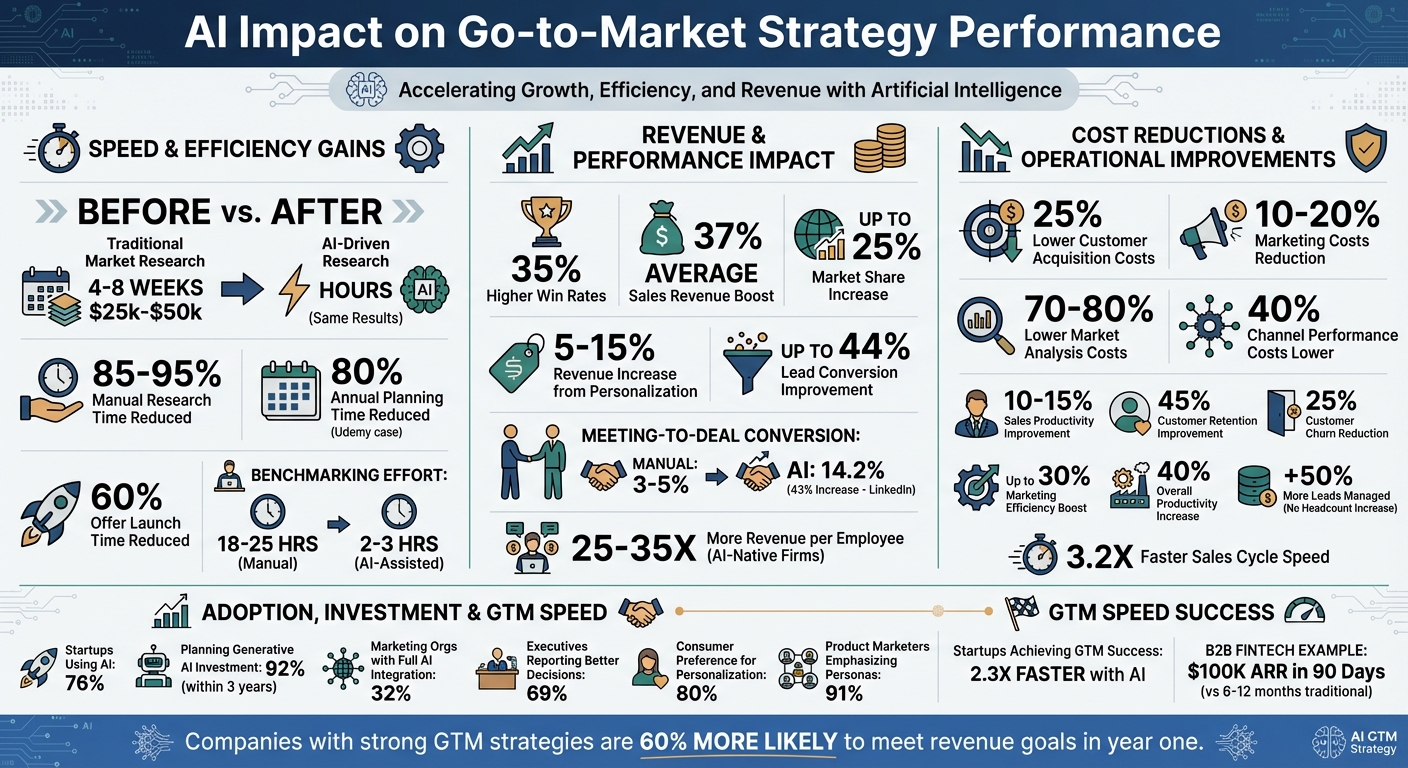
AI Impact on Go-to-Market Strategy Performance: Key Metrics and ROI
What is GTM AI?
sbb-itb-c336128
Using AI for Market Research and Insights
Traditional market research often takes 4–8 weeks and costs between $25,000 and $50,000 [12]. AI-driven research, on the other hand, can produce similar results in just hours by processing vast, diverse data streams. By consolidating fragmented information, AI uncovers emerging market segments and detects shifts in real time [2].
This technology has shifted the focus from demographic-based segmentation to behavioral-intent segmentation. Instead of grouping customers by age or location, AI analyzes what they aim to achieve, the technologies they use, and other public signals that indicate their readiness to buy. This enables companies to target micro-segments that were previously too specific to justify manual efforts [9][2]. These real-time insights also allow businesses to anticipate trends instead of reacting to them.
AI-Powered Trend Analysis
AI tools excel at identifying trends before they hit the mainstream by analyzing social media conversations, search behavior, and industry reports. Using Natural Language Processing (NLP), these tools interpret customer reviews, forum discussions, and social media posts to identify recurring pain points and evolving needs [8]. Companies leveraging AI for competitive intelligence have reported up to a 25% increase in market share by acting on these insights faster than their competitors [8]. Additionally, these tools reduce manual research time by as much as 85–95%, thanks to their ability to monitor sentiment and generate detailed reports [6][13].
Beyond spotting trends, AI also enhances buyer profiles by capturing customer behaviors in real time.
Building Buyer Personas with AI
AI has revolutionized the way businesses create buyer personas, moving from assumption-based methods to data-driven insights. Instead of relying solely on brainstorming sessions, AI uses behavioral data - like clicks, cursor movements, and purchase histories - to reveal how customers actually behave. Despite the importance of accurate personas, with 91% of product marketers emphasizing their value, many still depend on outdated methods [12].
"If you segment wrong, you position wrong. If you position wrong, you message wrong. If you message wrong, you sell wrong. The errors cascade." - Tamara Grominsky, Creator of PMA's Segmentation Certified programme [12]
AI-powered personas can be updated quarterly or even in real time, helping organizations stay agile in a constantly changing market. Some platforms now offer "synthetic personas", which are AI-driven models that simulate buyer reactions to messaging or competitor strategies. These simulations provide qualitative insights in under two hours, making them a useful tool for quick hypothesis testing before committing to larger research budgets [10]. While synthetic data shouldn't replace real human feedback for critical decisions, it offers an efficient way to test ideas early in the process [13].
AI-Driven Competitive Analysis for Market Positioning
AI-driven competitive analysis has reshaped how businesses understand their market position, moving from outdated quarterly reports to real-time, dynamic insights. In the past, competitive intelligence relied on static documents that were often obsolete by the time they reached decision-makers. Today, AI powers systems that continuously monitor competitors, analyzing everything from pricing strategies and product updates to customer feedback and hiring trends [4][15]. These systems use machine learning to uncover patterns in massive datasets, including social media chatter, news articles, and online forums - patterns that would be impossible for human analysts to detect at scale [11].
This evolution from static to live data has transformed how companies benchmark themselves. AI-powered platforms now pull structured data directly from competitor websites, turning elements like homepage messaging, feature lists, and pricing models into easily comparable metrics [14]. This allows businesses to measure themselves against numerous competitors simultaneously, a task that would take weeks without automation. Companies that use AI-generated competitive tools, such as battlecards, report a 71% boost in sales win rates. Additionally, these tools can slash the time needed to create positioning maps from 6–10 hours to just 20 minutes [16][17].
Competitor Monitoring and SWOT Analysis
AI has also revolutionized SWOT analysis by grounding it in real customer insights rather than relying on internal assumptions. A method often called "buyer-driven SWOT" uses AI to analyze data from sales calls (via platforms like Gong), CRM notes, and win/loss interviews to identify what truly influences buyer decisions [21][23]. For instance, instead of vague conclusions like "strong brand", AI might reveal that a "2-day implementation" is a decisive factor in winning enterprise deals.
Modern AI tools monitor a wide range of signals simultaneously. They track product developments through API documentation and release notes, watch for pricing adjustments via automated web tracking, assess buyer sentiment on review platforms like G2 and Capterra, and even analyze hiring trends on LinkedIn to identify shifts in competitor strategies [16]. This results in a continually updated, comprehensive view of the competitive landscape. As one McKinsey analyst observed, "firms that integrate automated intelligence pipelines outperform slower competitors in every major market" [15].
The efficiency gains are striking. AI-enhanced benchmarking can cut manual effort from 18–25 hours down to just 2–3 hours, while achieving about 90% accuracy [22]. Teams can now rely on "living" battlecards that update automatically with competitor changes, replacing static reports that often go ignored by sales teams. With these detailed insights, AI can also highlight untapped opportunities within the market.
Finding Opportunity Gaps
One of AI's standout abilities is identifying market gaps - areas where customer needs are unmet or competitors have overlooked key features. By analyzing customer reviews and forum discussions, AI can pinpoint recurring complaints or feature requests [11]. This allows businesses to address these gaps and seize opportunities that might otherwise go unnoticed.
AI also excels at detecting subtle "weak signals" by monitoring competitor job postings, patent filings, and sitemaps. These signals can reveal product development trends or strategic shifts before they are publicly announced [18][15][20]. Companies leveraging these insights have reported revenue increases of up to 20% [8].
"AI will uncover strategy shifts long before they appear in public markets." - Andrew Ng, Founder, DeepLearning.AI [15]
Additionally, AI-driven content gap analysis helps businesses redirect up to 40% of their annual marketing spend toward high-growth opportunities. By identifying impactful search terms and audience needs that competitors have missed, companies can focus their efforts on areas with the greatest potential [19][20].
Improving Messaging and Channel Selection with AI
Once you've nailed down your competitive edge, the next step is to craft messages that resonate and choose the best channels to deliver them. AI doesn't just help with market analysis - it also fine-tunes messaging and channel strategies to drive better results. By analyzing massive amounts of customer data, AI identifies precise audience segments - like "Series C SaaS companies with usage-based pricing and an open RevOps role" - and creates messaging tailored to their specific needs [24][25].
The results speak for themselves. Personalized marketing powered by AI can boost sales by 20%, and marketing leaders using AI report 60% faster revenue growth [25][26]. These results come from AI's ability to quickly test different messages and predict the most effective channels to use - all before spending a dime.
AI for Message Personalization
Generative AI tools can create a variety of targeted messages for different audience segments [25][26]. This isn't just about tweaking a few words; it's about crafting entirely different value propositions. For example, developers might respond better to messaging that highlights API flexibility, while CFOs might care more about cost savings and ROI.
AI also uses synthetic personas - virtual buyers that simulate real customer reactions - to test the strength of your messaging [10]. These personas can uncover potential objections or "landmine questions" you might face in sales conversations. For instance, if you claim "2-day implementation", synthetic personas might challenge the feasibility of that promise from different buyer perspectives. Companies that integrate these insights into competitive battlecards report winning 20% more competitive deals [10].
Christopher Good of EverWorker describes this as "always-on GTM", where AI continuously adjusts messaging based on market changes [1][4]. If a competitor changes pricing or releases a buggy update, AI enables your team to pivot messaging quickly. This agility matters - about 68% of sales opportunities involve direct competition [10].
To keep messaging consistent with your brand, ground AI in your company’s existing resources, like positioning guides and objection-handling playbooks [4]. Then, use AI to rapidly generate content variations and test them. As Clay University notes, AI can produce "good-enough work" exponentially faster, allowing you to experiment with ideas you might not have had time to test otherwise [24]. This efficiency can cut offer launch times by over 60% [26].
Next, let’s look at how AI can refine channel selection to complement these tailored strategies.
Predicting Channel Performance
AI doesn't stop at messaging - it also predicts which channels will perform best. By analyzing historical engagement data and competitor activity, AI identifies the most effective platforms for your campaigns. Scenario agents can even simulate budget shifts, like reallocating 15% to account-based marketing, to predict impacts on metrics like acquisition costs, pipeline coverage, and revenue [1][11].
AI-powered market sizing achieves about 85% accuracy, and companies using AI for go-to-market strategies see up to 50% better channel performance and 40% lower costs [27]. These results come from AI’s ability to process subtle behavioral signals that might otherwise go unnoticed. For example, AI can analyze GitHub activity, tech adoption trends, and job postings to determine how receptive a customer might be to certain channels. A developer might engage with solutions on GitHub, while a CISO might lean on professional associations - AI pinpoints these patterns and adjusts channel investments accordingly.
AI also tracks competitor activity across channels, scraping data from social media, SEO strategies, and paid media campaigns [1][4]. If your competitors are doubling down on a channel you’ve ignored, AI flags it for review. On the flip side, if they’re pulling back, AI helps assess whether it’s an opportunity or a warning.
| AI Capability | Impact on Messaging & Channel Selection |
|---|---|
| Synthetic Personas | Tests messaging credibility, identifies objections, and simulates buyer behavior [10]. |
| Predictive Analytics | Forecasts channel effectiveness and optimizes budget allocation [11][26]. |
| Generative AI | Creates personalized content variations for A/B testing across emails, ads, and social media [25][26]. |
| Real-time Monitoring | Enables quick adjustments to messaging based on competitor actions [4]. |
| Workflow Automation | Streamlines lead scoring and ensures the right message reaches the right person at the right time [25][7]. |
This shift from static annual plans to dynamic, always-on optimization is game-changing. Businesses using AI for marketing automation report a 10–20% drop in marketing costs, while overall productivity can increase by as much as 40% [28]. Start by applying AI to high-impact areas - like account-based marketing for a specific segment - before scaling it across your entire go-to-market strategy [1]. By connecting AI tools directly to your CRM and marketing automation platforms, you can ensure insights translate into actionable steps where it matters most [1][4].
Scaling Content Production and Personalization with AI
After fine-tuning your messaging and selecting the right channels, the next hurdle is producing content at scale without overburdening your team. AI steps in here, offering a way to streamline content creation and personalization while keeping pace with competitors. By automating the content lifecycle, AI transforms raw inputs - like sales call transcripts or product data - into polished assets such as blog posts, social media updates, and sales materials. This efficiency drives results across your marketing efforts [30].
The numbers back this up. 32% of marketing organizations have fully integrated AI into their processes, and businesses using AI report an average 37% boost in sales revenue and a 45% improvement in customer retention [29][34]. These benefits stem from AI's ability to produce tailored, high-quality content at scale. Personalized experiences, in particular, are powerful drivers of customer behavior, with 80% of consumers more likely to buy from brands offering tailored interactions [32].
Automating Content Creation
AI-powered workflows can manage entire content processes seamlessly. For example, a single workflow might take a webinar transcript, extract key themes, draft a blog post, create social media snippets, and generate follow-up emails - all without manual intervention [30][31]. Nathan Thompson of Copy.ai describes this approach as:
"The solution is not another disconnected tool. It is a fundamental redesign of your content operations known as an AI content supply chain." [30]
The secret lies in turning your "winning plays" - like successful blog formats or email sequences - into automated, repeatable workflows [31]. This ensures consistent quality and efficiency across your marketing efforts. Teams that train AI on their best-performing scripts, for instance, achieve a 14.2% conversion rate, compared to 3-5% with default prompts [36]. Tools like Copy.ai even offer free tiers, providing access to 2,000 words per month and over 90 content types, making it easy to experiment [30].
Start with impactful pilot projects, such as converting sales calls into case studies or generating SEO-friendly content from targeted keywords [31][29]. Integrating AI tools with your CRM and sales data ensures content is grounded in real customer needs and insights [31]. While AI handles much of the production, human input remains vital for strategic decisions and final quality checks to align with your brand's voice and standards [30]. This combination of automation and human oversight sets the stage for delivering personalized experiences that resonate with your audience.
Personalizing Customer Experiences
AI doesn't just speed up content creation - it customizes it for individual customers at scale. By analyzing data like demographics, behaviors, and CRM insights, AI generates targeted content and product recommendations [32][33]. This approach shifts from one-off campaigns to a continuously evolving "operating system" that learns and improves over time. As Ameya Deshmukh from Everworker explains:
"Personalization isn't a campaign; it's an operating system." [35]
The impact is undeniable. Scaled personalization can increase revenue by 5-15% and boost marketing efficiency by up to 30% [35]. Platforms like Salesforce's Einstein AI have helped businesses achieve up to a 44% rise in lead conversions and reduce customer churn by 25% [34]. These results come from AI's ability to respond instantly to triggers - such as a prospect revisiting a pricing page - by updating website content or sending personalized email sequences [35].
To implement personalization, focus on high-priority touchpoints like pricing pages, product pages, and lifecycle stages such as onboarding or re-engagement [35]. Establish clear brand guidelines, including tone and restricted phrases, to ensure AI-generated content aligns with your brand identity [35]. Set up regular testing cycles, introducing new experiments weekly and scaling successful strategies monthly [35]. Companies leveraging automation report a 10-15% improvement in sales productivity and a 10-20% reduction in marketing costs, with AI potentially enhancing overall business productivity by as much as 40% [28].
Real-Time Monitoring and Continuous Improvement
When scaling personalized content, keeping a close eye on performance in real time ensures your strategy stays aligned with shifting market dynamics.
Once your content and personalization efforts are live, it’s crucial to track how they perform and adjust as needed. AI takes this process to the next level, replacing the slow pace of monthly reviews with an always-on system. This system identifies opportunities and flags risks as they happen. Instead of waiting weeks to assess campaign outcomes, AI continuously monitors key metrics like deal velocity and competitor pricing changes [4], while also suggesting actionable steps [1].
The benefits are clear. A striking 69% of executives say AI enhances decision-making across their teams [37]. Companies leveraging AI in sales and marketing can even achieve revenue gains of up to 10% [38]. This isn’t just about creating more visually appealing dashboards - it’s about AI actively updating tools like CRM battlecards when a competitor lowers their prices or alerting sales teams when a high-value deal shows signs of stalling [4][1].
AI for Sales Forecasting and A/B Testing
Traditional sales forecasting often relies on pipeline stages, but AI goes beyond that. It evaluates factors humans might overlook, such as engagement quality, deal complexity, team dynamics, and even the tone of email replies. This allows AI to predict deal success with greater accuracy [1]. AI Workers track risks daily, such as deals lingering too long in a stage or lacking executive involvement, and adjust probabilities in real time - no need to wait for the next weekly forecast meeting [1].
For A/B testing, AI solves the challenge of starting from scratch. Instead of manually brainstorming email or landing page variations, AI instantly generates multiple options based on what’s already proven effective [5][40]. It even predicts which design elements will grab attention before campaigns go live [40]. The results speak for themselves: AI-led outreach achieves a 14.2% conversion rate, compared to just 3% for manual efforts. Companies using AI for testing also see efficiency gains of 15–30% [36].
Take Udemy as an example. In 2025, the company slashed its annual planning time by 80% by swapping spreadsheets for an AI-powered platform. This shift allowed them to make weekly adjustments instead of sticking to rigid annual plans [38]. Similarly, LinkedIn found that prospects exposed to ads before engaging with sales teams experienced a 43% jump in meeting-to-deal conversion rates [39].
These tools enable businesses to make quick, data-driven strategy changes.
Making Dynamic Strategy Adjustments
AI doesn’t just highlight issues - it provides actionable solutions. For example, if a competitor launches a new feature or changes pricing, AI Workers can automatically update sales battlecards, refresh nurture email sequences, and initiate account-based marketing efforts to protect at-risk deals [4][1]. This kind of agility is invaluable in fast-paced markets [4].
To streamline decision-making, integrate your CRM, marketing automation, and product data into a centralized "Revenue Command Center" [38][2]. AI can then run simulations, such as reallocating part of your paid search budget to account-based marketing, and predict the impact on customer acquisition costs and revenue before you make a move [1].
Nathan Thompson from Fullcast sums it up well:
"The winners set clear outcomes, connect their data, and wire AI into the motions that drive revenue. The laggards pile on point solutions and hope for lift." [38]
Consider holding a 30-minute weekly stand-up to review the top five AI-generated insights and decide on next steps [8]. Establish clear triggers, like launching a customer success intervention if three negative enterprise reviews appear within a month [8]. This consistent approach turns AI insights into a powerful competitive edge that grows over time.
Using Full-Stack AI Tools for Faster Execution
Full-stack AI platforms have transformed how products are launched by integrating research, content creation, and deployment into a unified system. This shift reframes go-to-market (GTM) strategies as engineering challenges [3].
Startups leveraging AI-powered tools are achieving GTM success 2.3 times faster than those relying on traditional methods. At the same time, market analysis costs have plummeted by 70–80% [43]. Companies with strong GTM strategies are 60% more likely to meet revenue goals within the first year of launching a product [42]. Additionally, AI-native firms are reporting 25–35 times more revenue per employee, as automated systems free up staff from manual tasks [41]. These advancements highlight how integrated platforms like ClackyAI are driving faster and more efficient GTM execution.
How ClackyAI Accelerates GTM Strategies
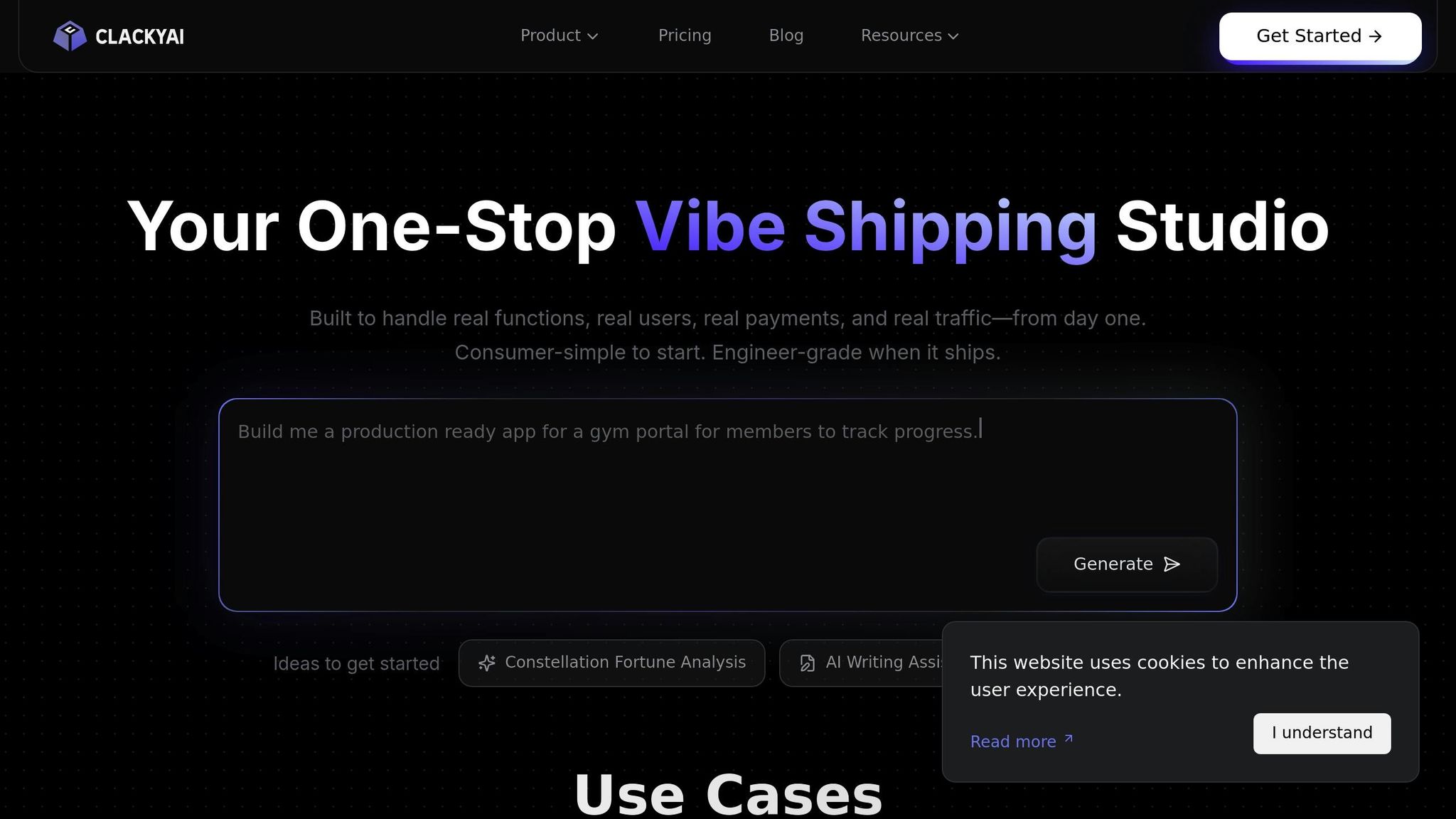
Tools like ClackyAI streamline the journey from concept to deployment by eliminating common development roadblocks. This full-stack AI platform offers features such as automated issue resolution, end-to-end codebase diagnostics, and cloud-based environments compatible with multiple frameworks. It even enables mid-sales cycle updates to address customer feedback in real time - a methodology referred to as "vibe GTM" [3].
For startups and indie developers, speed is critical. For instance, a B2B fintech startup using the Averi platform launched a GTM strategy in just three weeks, secured their first customer within six weeks, and reached $100,000 ARR in 90 days - a process that traditionally takes 6–12 months [43]. ClackyAI operates on a similar principle, bridging the gap between coding and deployment so teams can iterate quickly based on customer input. This approach addresses the execution delays often seen in traditional workflows, where waiting for development sprints can hinder progress.
ClackyAI offers flexible pricing plans, starting with a free Hobby tier. The Pro plan is priced at $29/seat/month, which includes 2,000 base credits and an additional 1,000 credits. For larger teams, the Business plan costs $59/seat/month, offering 4,000 base credits and an extra 2,000 credits.
Comparing AI GTM Tools
Choosing the right AI tools is essential to solidify your GTM strategy. While ClackyAI focuses on execution and deployment, other platforms specialize in research, competitive analysis, or content automation. Understanding how each tool fits into your workflow ensures a more cohesive strategy.
| Tool | Primary GTM Focus | Key Features | Target Audience | Typical Pricing |
|---|---|---|---|---|
| ClackyAI | Execution & Deployment | AI-driven coding, diagnostics, rapid deployment, real-time updates | Indie builders, startups, agile dev teams | Free to $59/seat/month |
| SEMrush | Research & Insights | SEO analysis, trend tracking, keyword gap analysis | Marketing teams, SEO specialists | Starts at ~$119.95/month |
| Klue | Competitive Intelligence | Competitor monitoring, SWOT analysis, automated battlecards | Sales enablement, product marketing | Custom enterprise pricing |
To maximize efficiency, consider adopting tools across the five-layer architecture: Identification (finding prospects), Enrichment (gathering data), Intelligence (AI-driven insights), Orchestration (automating workflows), and Execution (CRM and deployment) [36]. Teams that align these layers before implementing AI tools report 4–7 times higher lead-to-meeting conversion rates [36].
"The competitive frontier is now about orchestration, control, and a model's ability to operate as a reliable agent" - a16z Infrastructure [41]
Conclusion: The Future of AI in Go-to-Market Strategies
AI is redefining how companies approach go-to-market (GTM) strategies. What used to take weeks can now be accomplished in hours, transforming GTM from a traditional planning process into a fast-paced, engineering-driven challenge [4]. With 76% of startups already embedding AI into their operations and 92% of businesses planning to invest in generative AI within the next three years, the competitive edge now lies in creating faster learning loops rather than simply gathering better data [43][44].
The numbers speak for themselves. Companies leveraging AI in their GTM strategies report 35% higher win rates and cut customer acquisition costs by 25%. AI-powered sales teams manage 50% more leads without increasing headcount, and sales cycles are shortened by a factor of 3.2 [44][43]. But the future isn't just about speed - it’s about unifying fragmented data. By integrating CRM, web analytics, and product telemetry into a single identity graph, businesses can detect emerging micro-segments faster than their competitors [2].
AI-driven platforms like ClackyAI are already paving the way, shifting from tools that merely collect data to autonomous systems that handle entire workflows. These systems can research competitors, update battlecards in real time, and even launch personalized campaigns - all without human intervention [4][1]. However, this evolution requires careful governance. Companies that establish frameworks where humans set the rules and AI operates within defined limits will unlock actionable insights, turning predictions into concrete actions [38][2].
To succeed, businesses should focus on three key steps: automating repetitive tasks, adopting predictive models for lead scoring, and embracing generative AI for execution [46]. With only 25% of AI initiatives currently meeting ROI expectations, success hinges on clean data, collaboration across departments, and constant refinement [45]. Organizations that strike the right balance between AI's speed and human strategic oversight stand to achieve 5X revenue growth and 2.5X higher valuations through advanced AI strategies [46].
FAQs
What data do we need to start using AI for GTM?
To effectively incorporate AI into your GTM strategies, you’ll need a mix of critical data sources:
- Competitor data: Information like pricing, product launches, messaging, and distribution channels.
- Customer insights: Profiles, purchase history, and engagement patterns.
- External signals: Market trends and intent data.
By merging these data streams, AI can pinpoint opportunities, identify threats, and uncover emerging market segments. This allows for faster, more accurate GTM decisions. The key to success lies in building a strong data foundation to refine and improve your strategy.
How do we keep AI-driven competitive insights accurate and ethical?
To get precise and ethical insights from AI, it starts with using reliable tools that can analyze data from credible sources. This means working with platforms that are known for their accuracy and staying updated on the latest information.
Ethics play a huge role here. You need to ensure transparency in how data is collected and analyzed, follow privacy regulations, and regularly audit your systems to spot and reduce potential bias. AI isn't perfect, and that's where human oversight becomes essential. People can provide the context and judgment that AI alone might miss.
The key to trustworthy insights? A combination of clear guidelines, continuous monitoring, and a balanced partnership between AI and human expertise. This ensures your insights remain both accurate and ethically sound.
Where should we pilot AI in GTM for the fastest ROI?
To get the most out of your investment, begin with AI-powered tools for competitive analysis and market intelligence. These tools deliver real-time insights, enabling quicker decisions. Pay attention to key aspects like monitoring competitors’ pricing strategies, product changes, and buyer behavior. This helps you respond faster and stay more adaptable.
You can also leverage AI for quick market research and persona development. This allows you to fine-tune your messaging and positioning efficiently, setting the stage for broader AI integration across your go-to-market strategies.